
ABA operations software
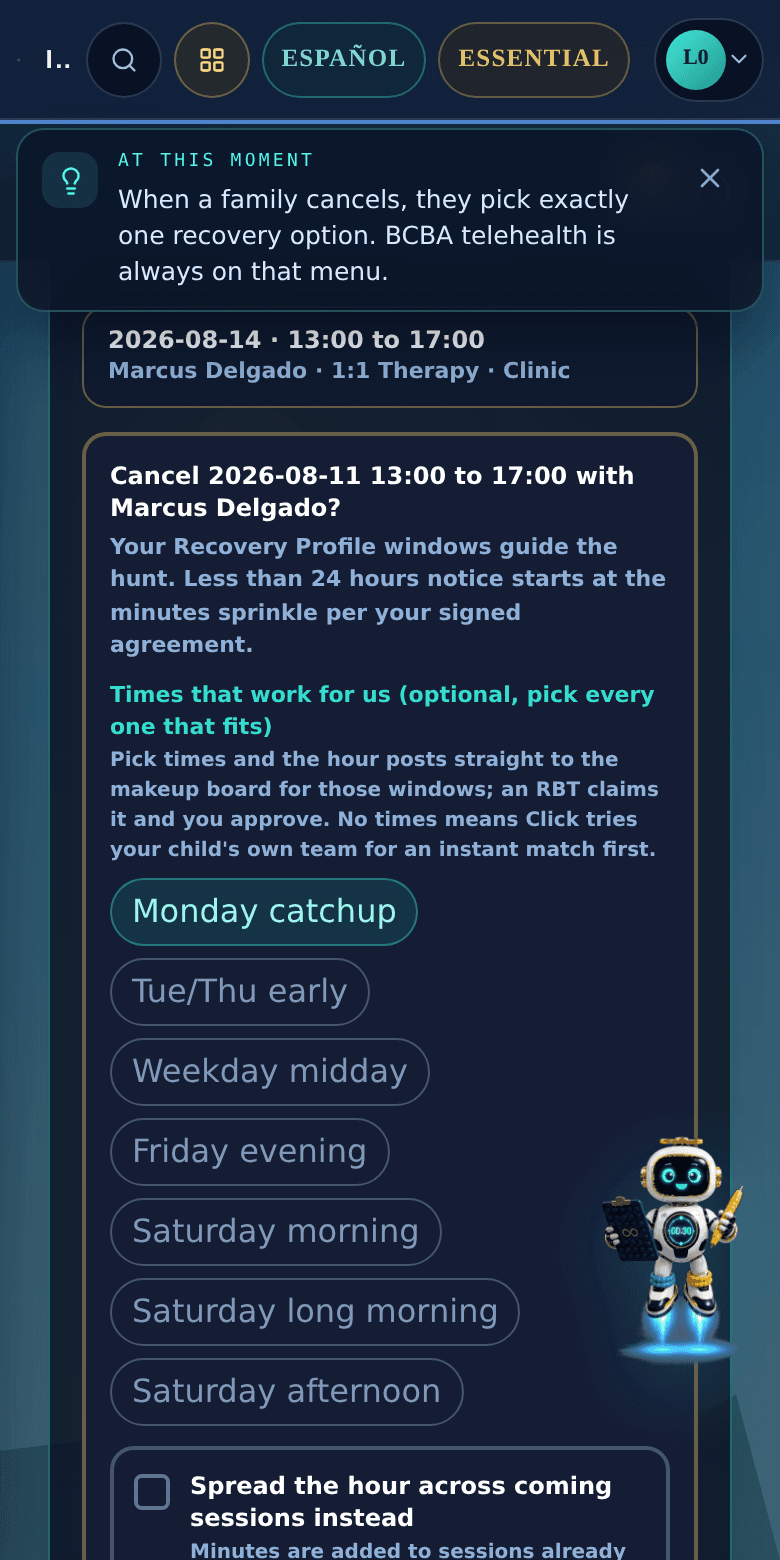
A cancelled session should never become a lost hour.
Infinite Suite OS opens a recovery path the moment a session cancels, and keeps the family, the technician and the clinic looking at the same hour until it is delivered or honestly written off.
Built by a Registered Behavior Technician with roughly a decade in the field across more than twenty service sites.
Working demo, fictional data, no PHIWhat you get
Three things a clinic can see on day one.
Infinite Suite OS

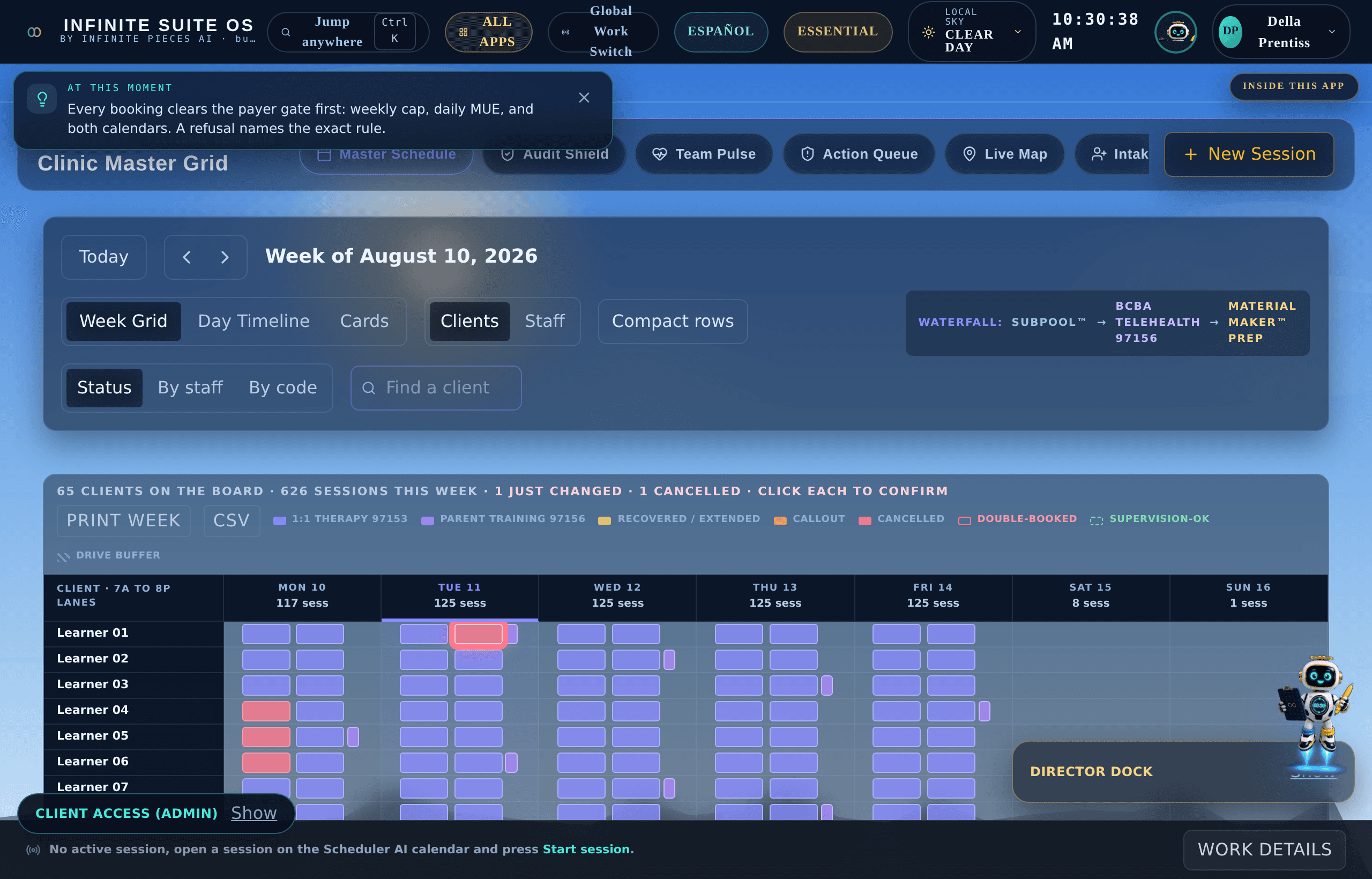
The week shows what was lost and what came back
Cancelled and recovered hours sit on the same board, so a director can see the shape of the week without assembling it from three systems and a group chat.
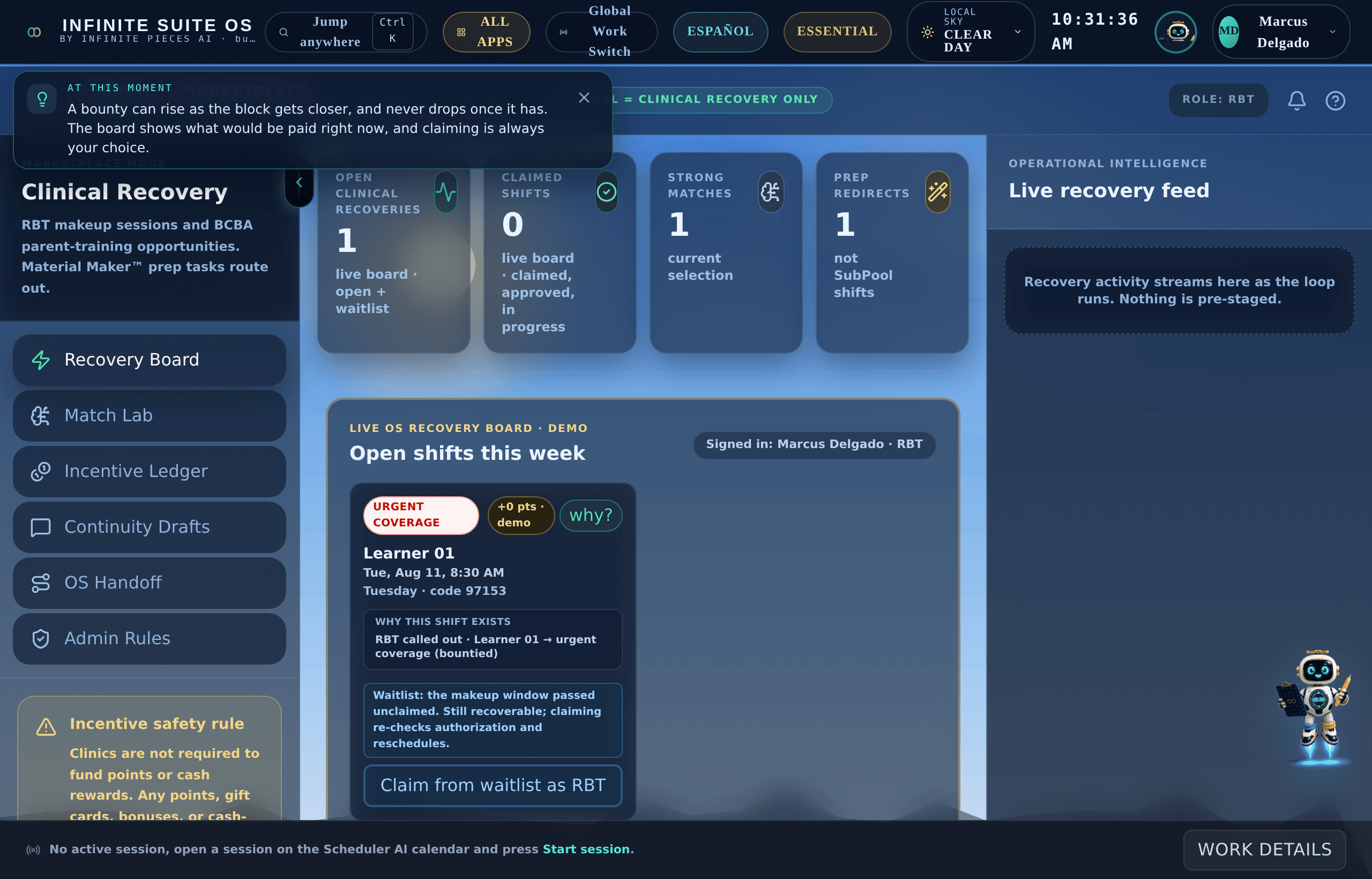
Technicians choose the work. Nobody is assigned to it
An open hour posts to a board qualified technicians can see, with the reason it exists written on the card. Claiming is a choice, every time.
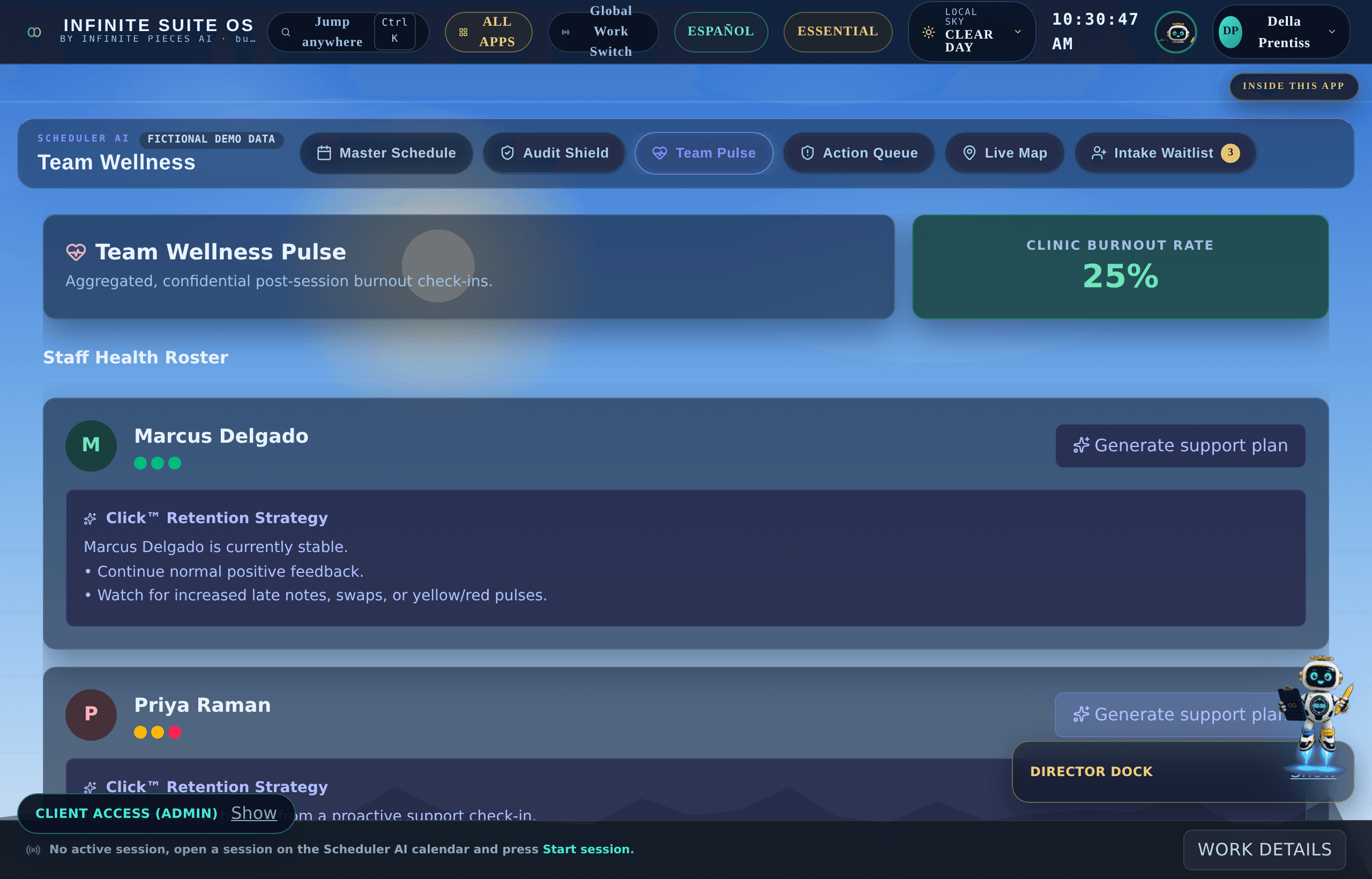
Burnout shows up on a board, not in a resignation letter
Technicians answer a short check-in after a session, and leadership sees the pattern rather than the individual answers. A check-in never changes who is offered an hour, which is the only reason the answers stay worth reading.
How a recovery actually happens
Four steps, and a person decides at two of them.
- 01
The family cancels
In their own app, on their own phone, without a phone call to the front desk.
- 02
The hour becomes a makeup offer
Not an empty slot to be filled. A specific hour, still belonging to that child.
- 03
A technician claims it
Qualified people see the offer and decide. Nothing is auto-assigned to anyone.
- 04
The family approves with one yes
No recovered hour reaches a family’s calendar without it.
The asking is the point. A makeup nobody agreed to is how families stop trusting a schedule, so the family holds the yes and the technician holds the choice, every time.

Who built it
I spent a decade watching good teams lose hours to the system around them.
Tyler Sheedy is a Registered Behavior Technician with roughly a decade in the field across more than twenty service sites. Infinite Suite OS was built during live clinic days, around the handoffs that actually happen between the field, the clinical team, caregivers and leadership.
Founding Clinic Program
Recovery layer
$15 per active client / month
Founding rate, from a $29 regular list. Runs beside your EMR. Sold today.
Full suite
$25 per active client / month
Founding rate, from a $49 regular list. Replaces the EMR. Not released.
The Founding Clinic Program has three slots. The first 90 days are free on either tier, with no card required. A founding clinic's rate is locked for life, on whichever tier it is on. Staff and family accounts are unlimited staff and family/caregiver accounts. Self-serve setup is free; onboarding beyond it is a paid service, included for founding clinics. Nothing to migrate on the recovery layer, which runs beside your EMR.
Straight answers
Before you book.
Do we have to replace our EMR?
No. Recovery Radar is designed to begin beside the EMR you already use. Billing and claims stay in your current system until equivalent production capabilities are explicitly released.
Is this a live product or a demo?
The public experience is a working demo running on fictional data. There are no customers, no live PHI and no production clinic deployment being represented.
What does it cost?
The recovery layer runs beside your EMR: $15 per active client per month founding, locked for life, from a $29 regular list. The full suite, the tier that replaces the EMR, is $25 per active client per month founding, locked for life, from a $49 regular list. The full suite is not released. Its price is published now so a clinic can plan, and the product sold today is the recovery layer. The Founding Clinic Program has three slots. The first 90 days are free on either tier, with no card required. A founding clinic's rate is locked for life, on whichever tier it is on. Setup is self-serve and free on both tiers. Onboarding and training beyond that is a paid service; founding clinics get it included. The recovery layer runs beside your EMR and writes nothing to it, so there is nothing to migrate and no migration fee on that tier. When the full suite replaces an EMR, migration is a priced package, waived for founding clinics.
Does the software decide anything clinical?
No. The BCBA and the treatment team own the plan. The recovery workflow helps a team deliver care that was already scheduled and authorized, and every booking clears the authorization and daily limit first.
Does it check credentials or state rules?
Not on the recovery path, and we will not pretend otherwise. What is checked before a booking is the authorization cap and the daily unit limit. Credential checking lives in a separate billing claims gate, a different gate doing a different job.
The published recovery model, with every assumption named, is on the recovery math page. It is a simulation, not a result claim about any clinic.
See it on one of your own weeks.
Bring a week that went badly. We will walk the same cancellations through the software and you can decide whether it would have helped.